
Co-Teaching Support
Building Strong Partnerships for Inclusive Classrooms
Co-teaching is a service delivery model in which two or more certified professionals share instructional responsibility for the same group of students in a shared learning space, with joint accountability for planning, instruction, and outcomes.
Experienced specialists, ready to help your educators succeed
CES specialists have led districts like Boston Public Schools, Chelsea Public Schools, and Concord Public Schools in their efforts to successfully establish effective co-teaching and inclusion practices in their classrooms. We offer a range of tailored professional development, team and individualized coaching, and technical assistance to both general and special educators. Whether your district or school is urban, suburban, or rural, we can help you to build high quality co-teaching programs for your students.
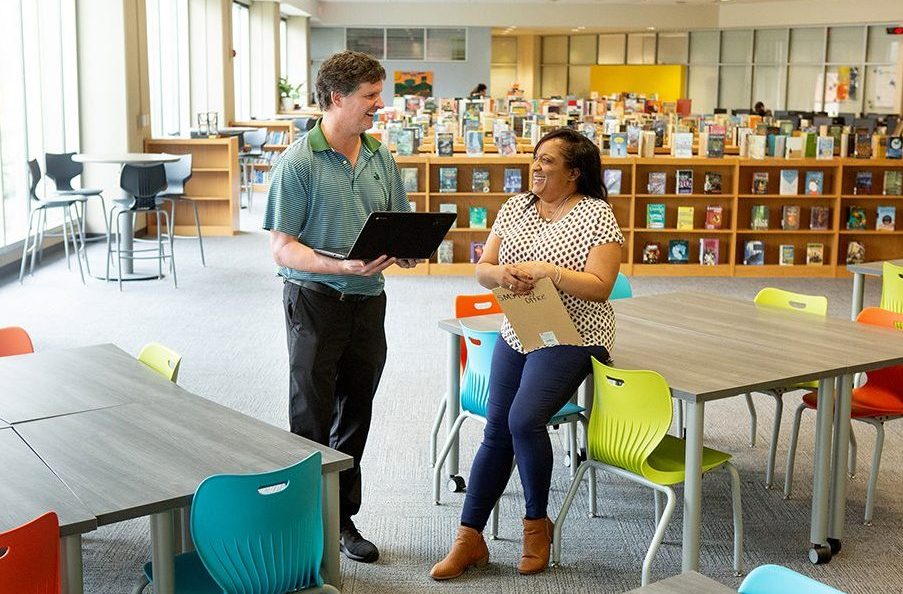
Photo by Allison Shelley for EDUimages.
Co-Teaching Can Make a Huge Impact
Co-teaching for inclusive classrooms can benefit not only students with disabilities, but all students who are having difficulty with or are misunderstanding an assignment, and build teachers’ knowledge and practice at the same time. It’s not intuitive for experienced teachers. Teachers often need practical coaching to make it work well. There are a number of models for co-teaching, but all require adjustment.
Ultimately, these models can lead to a more engaging and effective learning experience for students, stronger support for teachers, and better learning outcomes for students with disabilities. CES can help with tailored PD, coaching, and technical assistance.
Co-teaching professional learning menu
Professional development and coaching focus on both the mechanics (instructional approaches) and on communication, rhythm, and trust (cognitive contract and parity). Without both, educators may work hard, but won’t move smoothly or efficiently in the same direction.
This menu of professional development (PD) offerings supports educators and school leaders in establishing, sustaining, and evaluating high-quality co-teaching programs.
Click on the Categories to the right to see a listing of courses in each.
CES can create a custom program to suit your needs, or work with you based on the tiered programs described below. We are here to help!
Category 1: Foundations of Inclusive Collaboration - Building trust, clarity, and shared purpose
- Co-Teaching 101: Defining the Partnership
An introduction to what co-teaching is—and what it is not. Participants explore the essential features of effective co-teaching, including mutual ownership of students, shared responsibility, and pooled instructional resources. - Establishing the Cognitive Contract
This session focuses on the cornerstone of co-teaching success: shared beliefs about inclusive education. Partners work to build trust, honest communication, and “emotional consonance” to support strong instructional collaboration. - Roles and Parity
Participants clarify roles and responsibilities while examining the concept of parity—ensuring both educators are viewed and function as equals in the classroom, by students and colleagues alike.
Category 2: Mastery of the Six Instructional Approaches - Practical strategies for increasing instructional impact
- Low-Complexity Models
One Teach, One Observe – purposeful data collection to inform instruction
One Teach, One Assist – strategic, unobtrusive support during instruction - Small-Group Strategies
Parallel Teaching – dividing the class to increase participation and engagement
Station Teaching – rotating students through teacher-led and independent stations - Targeted & Whole-Group Models
Alternative Teaching – focused instruction for a small group of learners
Team Teaching – both educators jointly deliver instruction as “one brain in two bodies”
Category 3: Planning, Logistics, and Scheduling - Structures that make co-teaching sustainable
- Finding the Time: Collaborative Planning Protocols
Educators learn realistic strategies for securing co-planning time, including shared planning protocols, dividing preparation tasks, and creative scheduling solutions. - Strategic Scheduling for Inclusive Schools (Administrators & Scheduling Teams)
This session addresses the complexities of designing schedules that support inclusive practices—clustering services, reducing isolated course sections, and maintaining flexibility for student mobility. - Class Composition: Avoiding the “Inclusion Classroom” Trap
Participants examine best practices for distributing students with disabilities and other support needs across classrooms to avoid unintentional segregation.
Category 4: Instructional Quality and Accommodations - Ensuring access and rigor for all learners
- Differentiation in the Co-Taught Classroom
Teachers learn a practical framework for accommodations, including adjustments to content, environment, instructional structure, and presentation. - High-Quality Instruction for Students with Emotional Disabilities (ED)
Grounded in research, this session focuses on proactive classroom management, shared accountability, and instructional strategies that support engagement and social-emotional growth.
Category 5: Leadership, Observation, and Evaluation - Strengthening programs through feedback and data
- Administrator Training: Observing Co-Teaching
School leaders learn how to recognize indicators of effective co-teaching and provide meaningful feedback—centered on how instruction changed because two educators were present. - Measuring Impact: Data-Driven Program Quality
Participants explore ways to collect and analyze implementation data and student outcomes to evaluate program effectiveness and guide continuous improvement.
Co-Teaching Training Program Options
- Schools new to co-teaching
- Schools new to co-teaching
- Newly formed co-teaching pairs
- Educators and leaders seeking a common language and vision
- Schools actively implementing co-teaching
- Teams seeking consistency and instructional impact
- Administrators supporting inclusive classrooms
- Districts scaling co-teaching across multiple schools
- Administrators and leadership teams
- Schools focused on long-term program quality
- School improvement goals
- Special education or MTSS initiatives
- Staffing models and scheduling constraints
- Co-Teaching 101: Defining the Partnership
- Establishing the Cognitive Contract
- Roles and Parity in the Co-Taught Classroom
- All Tier 1 sessions, plus:
- Mastery of the Six Co-Teaching Instructional Approaches
- Collaborative Planning Protocols
- Differentiation and Accommodations in the Co-Taught Classroom
- Focus on literacy, math, or behavior supports
- Support for students with emotional disabilities (ED)
- Classroom modeling or coaching cycles
- All Tier 2 sessions, plus:
- Strategic Scheduling for Inclusive Schools
- Class Composition and Equity in Inclusion
- Administrator Training: Observing Co-Teaching
- Measuring Impact: Data-Driven Program Quality
- Program audits or implementation reviews
- Leadership coaching
- Data dashboards and evaluation tools
- Shared understanding of effective co-teaching practices
- Clear roles and expectations between partners
- Strong foundation of trust and collaboration
- Increased instructional intensity and student engagement
- Stronger co-planning routines
- Improved access to grade-level curriculum for all learners
- Sustainable co-teaching structures and schedules
- Consistent observation and feedback practices
- Clear evidence of program effectiveness
- 3 half-day sessions or 1 full day + follow-up
- In-person or virtual
- 2–3 full-day workshops or spread across a semester
- Blended in-person and virtual learning
- Multi-month or year-long partnership
- Onsite, virtual, or hybrid